You keep hearing about climate summits and want to know what is COP. It stands for Conference of the Parties, the yearly decision-making meeting of countries under the UN climate treaty.
This guide is part of our wider climate news coverage.
| Item | Value |
|---|---|
| Parties to the UNFCCC | 198 Parties (197 States and the EU) |
| UN climate treaty | Adopted in 1992; entered into force in 1994 |
| First climate COP | Berlin, 1995 |
| Typical attendance | 40,000-60,000 people |
| Typical length | Around two weeks |
| COP31 | Antalya, Türkiye, 9-20 November 2026 |
These figures come from IIED’s explainer, updated 5 November 2026, and CISL’s guide. They can change, so check the source before you rely on them.
What does COP stand for?
COP stands for Conference of the Parties. IIED describes it as the supreme decision-making body of an international treaty, where the countries bound by the treaty review how it is being carried out and agree on goals and next steps.
Every COP has a country host, known as the COP president, and each conference is referred to by its number in the series. The best-known series belongs to the UNFCCC, the United Nations Framework Convention on Climate Change, which was adopted in 1992 at the Rio Earth Summit and entered into force in 1994, according to IIED.
The treaty’s aim, as CISL quotes it, is to stabilise greenhouse gas concentrations at a level that would prevent dangerous anthropogenic (human-induced) interference with the climate system. It works as an umbrella agreement, so other binding decisions are made and implemented underneath it. That includes the Paris Agreement, agreed at COP21 in 2015.
Other treaties have their own COPs. Per IIED, the biodiversity and desertification conventions meet every two years, while the climate COP meets annually. The term is most often linked to the climate treaty.
Who attends a climate COP
Only parties have the legal right to negotiate and make decisions at the UNFCCC COP, says IIED. CISL counts 198 Parties: 197 States and the EU.
IIED sorts the people in and around the talks into three groups:
- Parties: national governments and regional blocs such as the European Union.
- Negotiating groups: alliances based on shared economic or geographic interests, such as the Alliance of Small Island States or the Least Developed Countries Group.
- Observers: civil society organisations, youth and women’s groups, Indigenous Peoples and research organisations, who can advise delegations but do not have a formal vote.
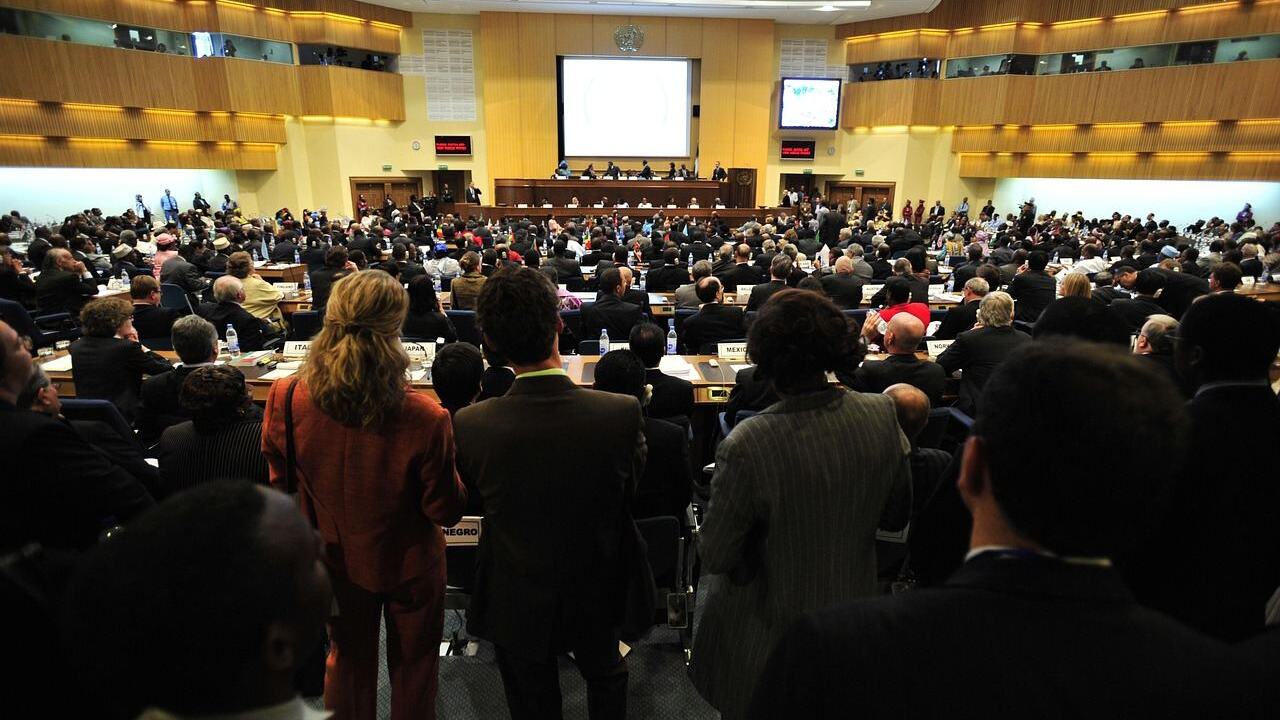
Between 40,000-60,000 people typically attend a COP, according to IIED, including delegates, scientists, journalists and businesses. Decisions are reached by consensus, which Monash Lens says can give individual nations substantial, often disproportionate, influence.
The wider scene is debated. In an October 2023 analysis, Monash Lens notes that some argue the civil society presence fosters greenwashing rather than genuine action, while others say it gives civil society a vital platform.
How a COP works: timing, hosts and agenda
A COP usually runs for around two weeks, per IIED. The UNFCCC COP happens every year unless the parties agree otherwise, CISL says, and the 2020 meeting was postponed until 2021 because of the COVID-19 pandemic.
Hosting rotates between the five UN regions, and the first COP took place in Germany in 1995, according to ECIU. The same briefing says COPs usually take place in November/December, supported by intersessional meetings in May/June in Bonn.

What is on the agenda
ECIU’s briefing, last updated in October 2021, groups the agenda into four broad issues:
- Mitigation: cutting emissions to limit future warming.
- Adaptation: changing infrastructure and the way people live and work to cope with climate impacts.
- Finance: rich nations providing financial support to poorer and middle-income countries for mitigation, adaptation, and loss and damage.
- The Paris rulebook: the rules on how delivery against the Paris Agreement is measured and judged.
ECIU describes the Paris Agreement’s temperature aim as keeping warming to well below 2°C compared with pre-industrial times, aiming for 1.5°C. As of its October 2023 analysis, Monash Lens said current progress remained sorely insufficient, and the ECIU briefing is where the aim is set out.
Milestones from past COPs
Monash Lens points to several turning points in the history of the talks:
- COP1, Berlin, 1995: major countries committed to annual discussions on climate change and emissions reductions (Monash Lens).
- COP3, Kyoto, 1997: the Kyoto Protocol obliged industrialised nations to curtail greenhouse gas emissions, and ECIU says it ran from 2005 to 2020.
- COP15, Copenhagen, 2009: the official target of limiting temperature rise to below 2°C crystallised (Monash Lens).
- COP21, Paris, 2015: all nations unanimously adopted the Paris Agreement (Monash Lens).
- COP27, Sharm El-Sheikh, 2022: a Loss and Damage Fund was established to compensate less-developed nations (Monash Lens and CISL).
Science feeds into the talks too. Monash Lens says the Intergovernmental Panel on Climate Change, established in 1989, produced assessment and special reports that have been key in precipitating significant COP decisions. You can read more about that work in our guide to IPCC reports.
What was agreed at COP30, and what is COP31?
CISL lists COP30 in Belém, Brazil, as 10-21 November 2025 and says it concluded with a voluntary plan to curb fossil fuels, a goal to triple adaptation finance and new efforts to strengthen climate targets.
IIED adds that the commitment is to triple adaptation finance by 2035, alongside 59 indicators to track progress on global adaptation. However, it notes the target had been pushed back from 2030 and the agreement did not include any concrete financial commitments.
IIED warns that weaker commitments leave the countries and communities most vulnerable to climate change facing greater uncertainty. It also says COP30 did little to advance the Baku-to-Belém roadmap to scale up finance for climate action to US$1.3 trillion by 2035.
Money has long been the sore point. Monash Lens explains that the convention assigns leadership to developed nations, which agreed to provide financial aid, knowledge and technology to less-developed nations. ECIU recorded that in 2009 rich countries pledged $100bn per year to poorer countries by 2020, and as of its October 2021 update that threshold had not yet been achieved.
As of IIED’s explainer, updated 5 November 2026, COP31 takes place in Antalya, Türkiye, from 9-20 November 2026. IIED says the focus will be on accelerating implementation rather than concrete negotiation outcomes. Because the talks run to 20 November, check the final decisions once the conference closes.
Frequently asked questions
How often is a COP held?
Show answer
The UNFCCC COP happens every year unless the parties agree otherwise, according to CISL. The 2020 meeting was postponed until 2021 because of the COVID-19 pandemic.
Can observers or companies vote at a COP?
Show answer
No. IIED says only official parties have the legal right to negotiate and make decisions, while accredited observers can take part in events and advise delegations but do not have a formal vote.
Is COP the same as the UNFCCC?
Show answer
No. The UNFCCC is the treaty, and COP is its main decision-making body, which includes representatives of all the Parties, as CISL explains.
Do COPs actually achieve anything?
Show answer
Views differ. In October 2023, Monash Lens argued that each COP since 1995 has yielded only incremental reductions in emissions, yet it has reached milestones such as the Paris Agreement and remains the most potent mechanism for pressuring governments.